
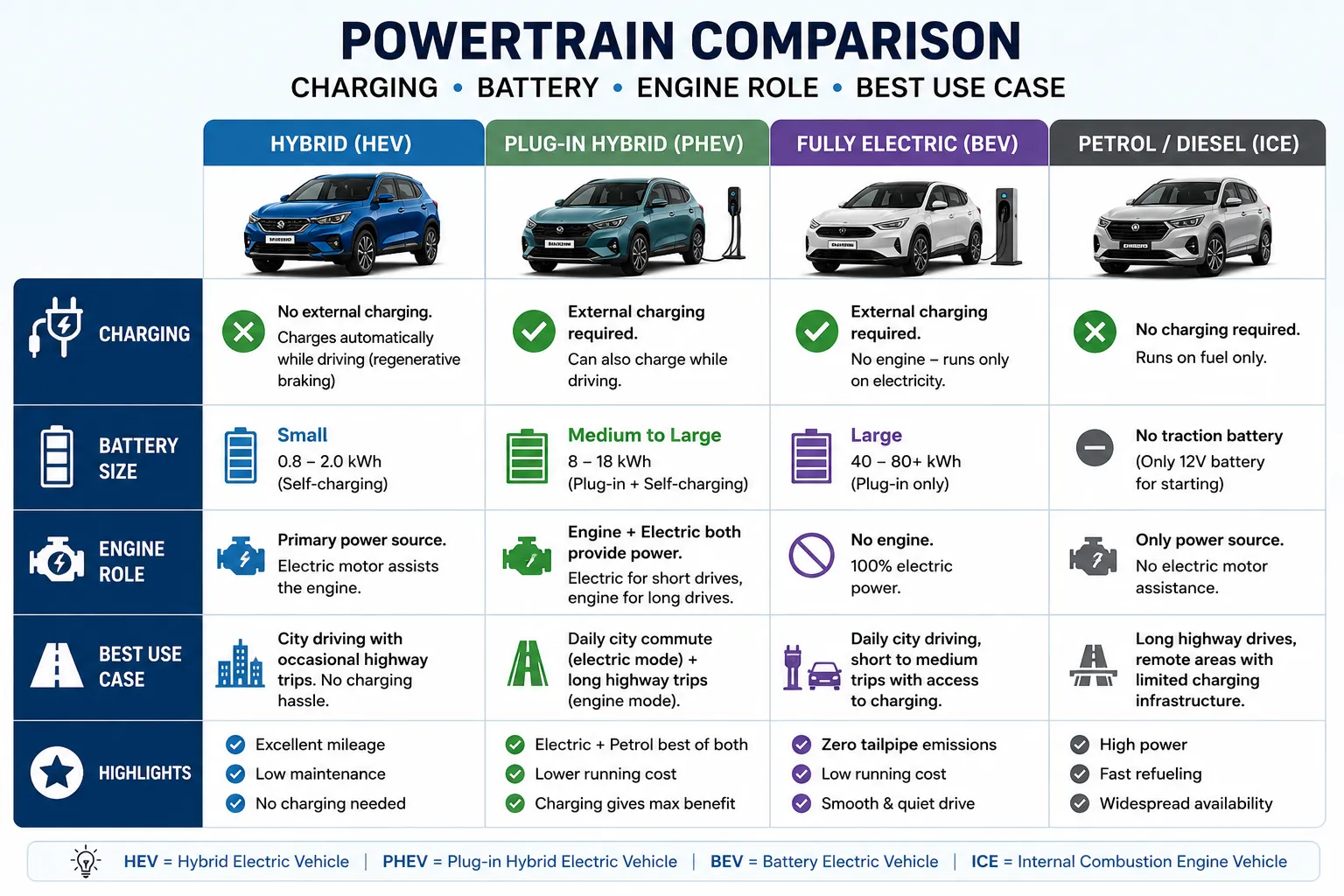
Hybrid cars are no longer one simple category. Buyers now see terms such as HEV, PHEV and EREV, and all three use petrol and electricity in different ways. The names can sound technical, but the core difference is simple: how much the car depends on the battery, whether you can plug it in, and what the engine actually does.
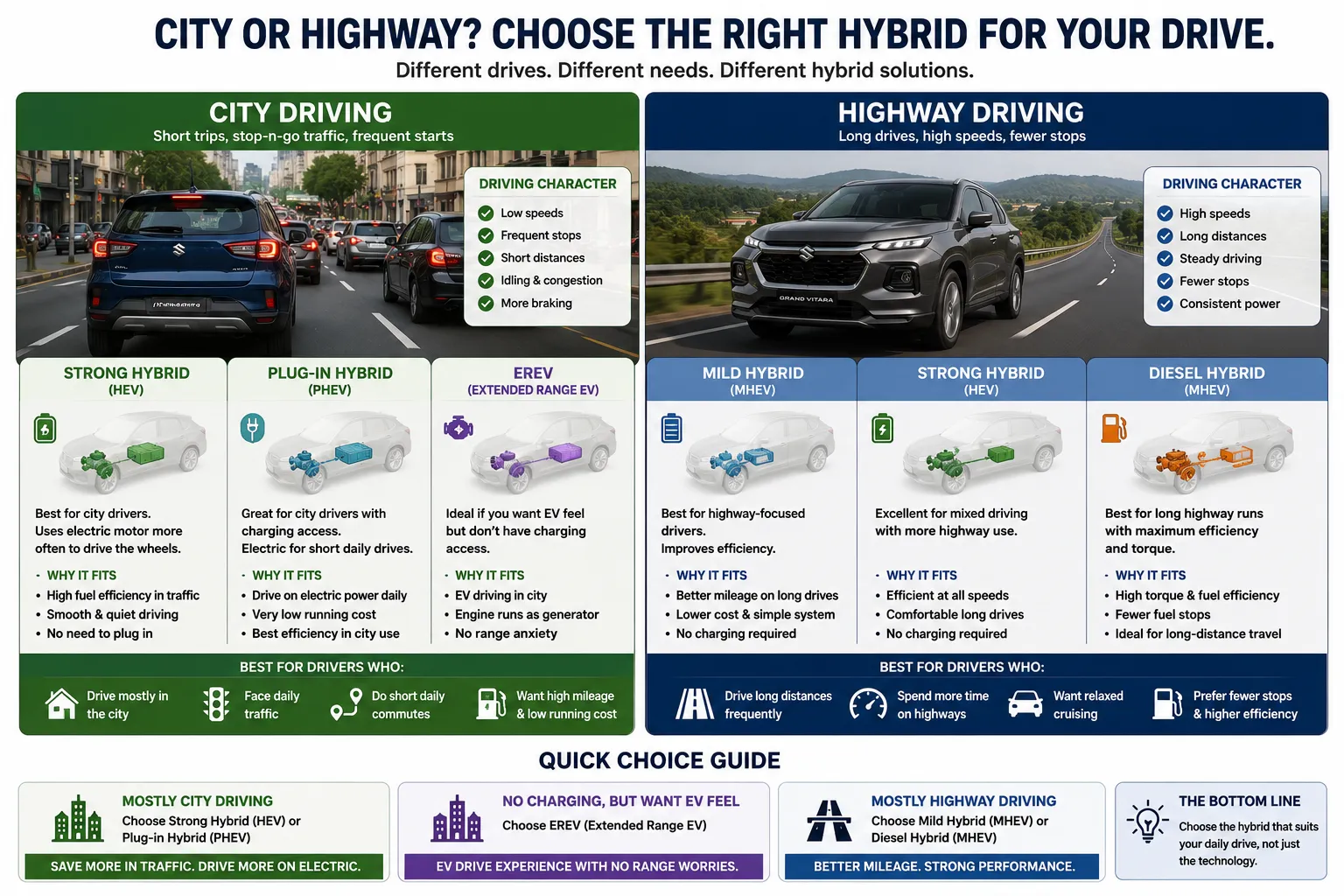
Understanding the Three Hybrid Types
The biggest difference between HEV, PHEV and EREV is how electricity and petrol work together. Some hybrids charge themselves automatically, some need charging from an external source, and others use the petrol engine mainly as a backup generator.
Quick Rule: HEV = self-charging hybrid, PHEV = plug-in hybrid, EREV = electric vehicle with a petrol-powered range extender.
What is an HEV?
HEV stands for Hybrid Electric Vehicle. This is the familiar strong-hybrid format seen in cars such as the Toyota Urban Cruiser Hyryder and Maruti Suzuki Grand Vitara Strong Hybrid. An HEV combines a petrol engine, electric motor and a relatively small battery pack.
You do not plug an HEV into a charger. Instead, the battery charges automatically through regenerative braking and engine power. During slow city driving, the vehicle can run briefly on electric power before switching seamlessly between petrol, electric assistance or both.
The biggest HEV advantage is convenience. You use it like a normal petrol car while enjoying better fuel efficiency, particularly in urban traffic. The limitation is electric-only driving range, which remains very short because of the small battery.
Best For: Buyers who want better mileage without worrying about charging infrastructure.
What is a PHEV?
PHEV stands for Plug-in Hybrid Electric Vehicle. A PHEV uses a much larger battery than an HEV and can be charged from an external power source.
In many international markets, PHEVs can travel meaningful distances using only electricity before switching into hybrid mode. This makes them ideal for buyers with short daily commutes who can charge at home or work.
However, a PHEV only delivers its full benefit when regularly charged. Without charging, owners are effectively carrying around a heavier and more expensive hybrid system without using its main advantage.
Best For: Drivers who have access to charging and want electric commuting with petrol backup for long-distance travel.
What is an EREV?
EREV stands for Extended Range Electric Vehicle. This is one of the newest powertrain formats gaining attention globally.
Unlike a traditional hybrid, an EREV behaves much more like an electric vehicle. The wheels are usually powered by electric motors, while the petrol engine mainly functions as a generator that recharges the battery when needed.
This setup creates a more EV-like driving experience while reducing range anxiety. However, it still requires fuel, engine maintenance and additional mechanical complexity compared with a pure battery-electric vehicle.
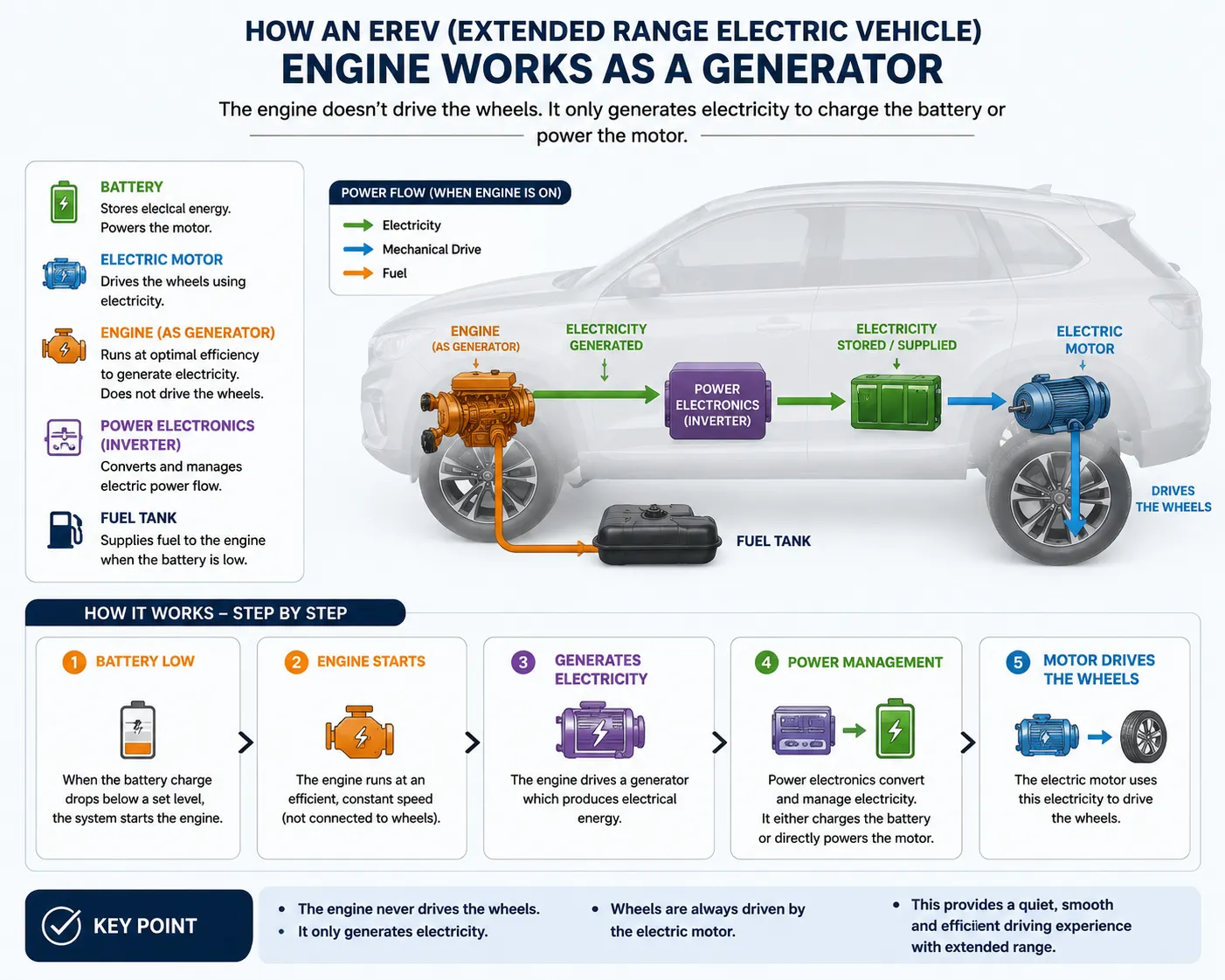
Best For: Buyers who want an EV-like experience but still need a petrol-powered backup for longer journeys.
HEV vs PHEV vs EREV Comparison
| Feature | HEV | PHEV | EREV |
|---|---|---|---|
| External Charging | No | Yes | Yes |
| Battery Size | Small | Medium/Large | Large |
| Engine Role | Drives Wheels | Drives Wheels & Supports Battery | Primarily Generator |
| Electric-Only Driving | Limited | Moderate | Extensive |
| Best Use Case | Daily Fuel Savings | Short EV Commutes | EV Feel With Backup |
Which Hybrid Type Makes Sense for India?
For most Indian buyers today, HEVs remain the most practical choice. They are widely available, easy to use and deliver excellent efficiency in traffic-heavy urban conditions.
PHEVs could become attractive if more manufacturers launch competitively priced models and charging infrastructure continues to improve. EREVs are promising but remain a niche concept globally and are still rare in India.
CompareAuto Verdict: Choose an HEV if you want simple fuel savings with no charging dependency. Consider a PHEV if you can charge regularly and want electric commuting benefits. Watch EREVs closely if you like the EV driving experience but still want the reassurance of petrol backup for longer journeys. The best hybrid type is not the most advanced one—it is the one that fits your daily routine.
Frequently Asked Questions
What is the main difference between HEV and PHEV?
An HEV charges itself while driving and cannot be plugged in. A PHEV has a larger battery and can be charged from an external charger.
Is an EREV the same as a PHEV?
No. An EREV is usually driven primarily by electric motors, while the petrol engine mainly works as a generator. Many PHEVs can use both the engine and electric motor to drive the wheels.
Which hybrid type is best for India?
HEVs are currently the most practical choice for most Indian buyers because they do not require charging and are already available in mainstream segments.